When AI Buys the Reactor
What's really happening on-the-ground around the datacenters.

Picture This
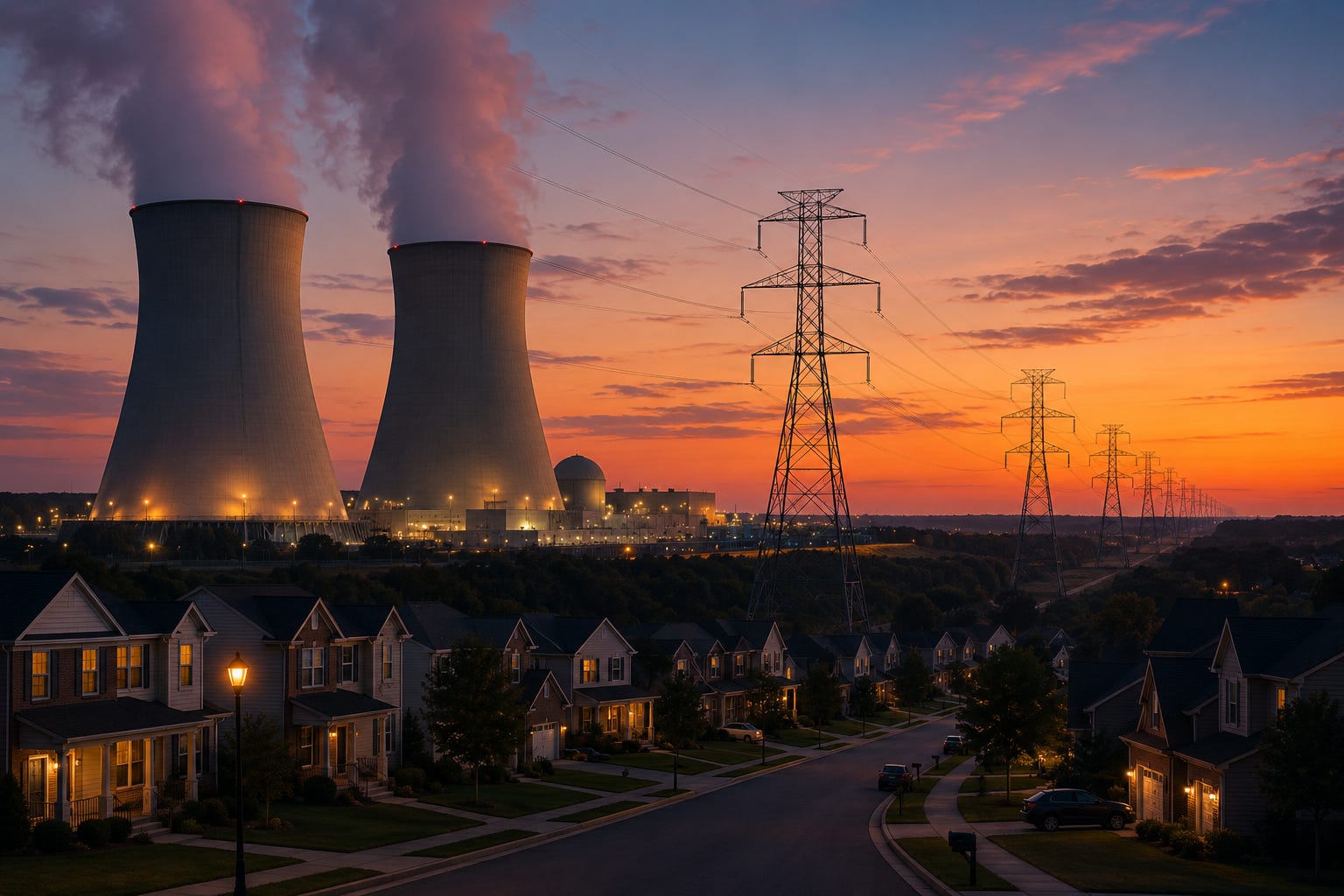
It’s a Wednesday morning in 2027. You’re in your kitchen in Loudoun County, Virginia. You open your Dominion Energy bill and notice a new line item. Your monthly cost is up $11.24. The bill cites “capacity charges” — the cost of making sure the grid has enough power on the worst day of the year.
You didn’t buy a new appliance. You didn’t add a room. Your habits haven’t changed.
What changed is that twenty miles up the road, the data centers in Ashburn now consume more electricity than the city of Atlanta. They’ll consume more again next year. And the cost of building the grid to keep up with them is being apportioned — quietly, by your state’s utility commission, by the regional grid operator, by mechanisms most people couldn’t name — to your meter.
You didn’t sign up to subsidize a server farm… but you did anyway.
The Headline They Showed You
You’ve probably seen the number, somewhere. The four biggest US tech companies — Amazon, Google, Microsoft, Meta — have together committed roughly $725 billion in capital expenditure for 2026 alone. That’s up 77% from $410 billion in 2025. Goldman Sachs projects $7.6 trillion in cumulative AI infrastructure spending between now and 2031. Nvidia’s Jensen Huang told the audience at the company’s GTC conference in March that this is “the largest buildout of human history.”
He’s not wrong. It is.
What the headline doesn’t tell you is what’s being bought, and it doesn’t tell you who’s paying for the parts that the press release leaves out.
That is what I want to walk through here, because I think the readers of this Substack— most of whom understand systems thinking better than most journalists — deserve a careful map of where the costs of this buildout are actually landing. Not the trillion-dollar figures everyone is quoting. The downstream ones. The bill. The air. The water. The reactor.
I Was Eight When Three Mile Island Melted Down
I remember it the way you remember the few moments in childhood when the adults around you go quiet in a way you don’t recognize.
It was March 28, 1979. The newscaster’s voice. The diagrams on television showing a reactor in central Pennsylvania. The maps drawn around the plant in concentric circles. The word “containment” used in a way that didn’t feel containing.
For days, the country waited to find out whether a partial core meltdown (which is what Three Mile Island’s Unit 2 was experiencing) would become a full breach. Whether the radiation already leaking would harm the people in Middletown, in Harrisburg, in the small towns downwind. Pregnant women and pre-school-age children were evacuated within a five-mile radius. The governor of Pennsylvania went on television. The President even flew in.
The accident did not become Chernobyl. The containment held… barely. Unit 2 was closed permanently. Unit 1, which had been brought offline during the crisis, eventually returned to service and ran cleanly for decades until it was decommissioned in 2019 for economic reasons.
That is the Three Mile Island that lives in my memory. A near-miss, and a lesson the nuclear industry took seriously for four decades — about humility, about defense in depth, and about the gap between what the operators see on a panel and what is actually happening inside a reactor.
In September 2024, I read this:
“Constellation Energy will restart Three Mile Island Unit 1.” The plant will be renamed the Crane Clean Energy Center. Microsoft has signed a twenty-year power purchase agreement for 835 megawatts. One hundred percent of the plant’s output will go to Microsoft data centers, including those in Pennsylvania, Virginia, Ohio, and Illinois. Crane is expected to be operational in 2027 or 2028.
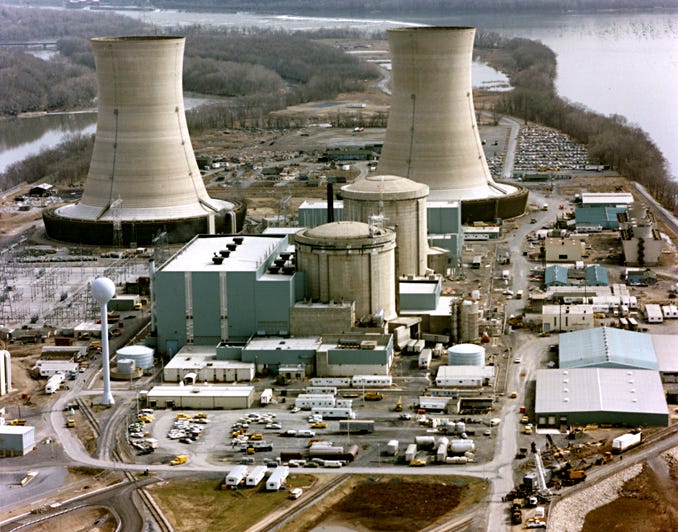
I want to be precise about my reaction here, because the nuclear question is one where reasonable people disagree, and I am not anti-nuclear. Nuclear fission is one of the cleanest sources of baseload electricity humans have ever developed, and any serious, forward-looking strategy almost has to include it. If the question were whether to bring TMI back to power the regional grid — to displace the lost coal-fired plants, to relieve gas plants, and to give Pennsylvania and PJM customers downstream a more reliable and robust resource — I would be sympathetic.
That is not what is happening.
What is happening is that a multi-trillion-dollar technology company has executed a private contract to wall off 835 megawatts of carbon-free electricity behind the meter — meaning the power produced at Three Mile Island will not flow into the public grid. It will flow into Microsoft’s data centers. The plant is being restarted for one customer.
That is a different situation entirely.
It also isn’t an isolated situation. Amazon and Talen tried to do the same thing at the Susquehanna nuclear plant in Pennsylvania, expanding their behind-the-meter share from 300 to 480 megawatts. In November 2024, the Federal Energy Regulatory Commission rejected the deal, in a 2–1 ruling that has since been upheld. Talen is now suing FERC in federal court. The legal question is whether nuclear power that exists because the public bore the regulatory burden of building it can be carved out and sold to a single hyperscaler over the public grid’s head.
I do not pretend to know how that legal question resolves. However, I do know what the underlying pattern looks like, because I have watched a version of it play out in every infrastructure transition of the last forty years.
The reactor is coming back, but the power isn’t coming to you.
What’s Quietly Replacing the Grid
If you only looked at the press releases, you might believe the data center industry has been quietly going green — solar arrays, wind PPAs, nuclear restarts.
If you look at what is actually being built, you see something different.
Meta’s Hyperion campus in Richland Parish, Louisiana — a $27 billion AI facility that will be the largest in Meta’s global fleet — will be powered by ten natural gas plants. That number was three when the project was first announced. Meta tripled it. Total generation: 7.46 gigawatts.
xAI’s Colossus 1 supercomputer in South Memphis — the facility training Elon Musk’s Grok — began operations with as many as 35 methane-burning gas turbines, none of which had air permits. After the Southern Environmental Law Center filed a notice of intent to sue, xAI removed some of the turbines and was granted permits for 15. The NAACP is now suing xAI for Clean Air Act violations.
OpenAI’s Stargate data center in Abilene, Texas — the flagship of a $400 billion buildout — runs on what the industry calls “aeroderivative” turbines. That is industry-speak for natural gas engines based on airplane jet engines. They were chosen because they could be deployed faster than waiting for grid power.
Google is partnering with the developer Crusoe on a 933-megawatt natural gas plant in North Texas. Meta is deploying more than 800 mobile mini-turbines in El Paso.
Texas now has roughly 58 gigawatts of natural gas power in planning or construction. According to industry trackers, nearly half of the gas plants currently under construction in Texas will serve data centers exclusively, and they will never connect to the regional grid… at all.
The industry has a term for this. They call it the “AI Bridge.”
A bridge is supposed to be temporary. A bridge is supposed to take you from one side of a river to the other. But these are not temporary. The Meta plants in Louisiana are not coming offline in five years. The 800 mini-turbines in El Paso are not going anywhere. The Memphis permits run for years.
We are not building a bridge. We are building a multi-decade methane infrastructure commitment, mostly in the South, mostly in communities with the least political leverage to push back, and we are doing it so quickly that the local utility commissions are still drafting the rules for how to regulate it.
The Bridge is not a bridge… it is the destination.
The Air in Boxtown
Memphis is the case study I cannot get out of my head, and the case I want every reader to know about, because it tells you exactly how this pattern works on the ground.
Boxtown is a neighborhood on the south side of Memphis. It was founded after the Civil War by formerly enslaved people who used wooden boxcars to build their first homes. The neighborhood today is approximately 90 percent Black. It hosts 18 industrial facilities — a power plant, an oil refinery, a wastewater treatment plant, a steel mill.
The cancer rate in Boxtown is four times the national average. The surrounding region ranks second in the United States for asthma-related emergency room visits and seventh in asthma-related deaths.
This is where xAI put Colossus.
When the facility began operations in 2024, xAI installed up to 35 methane gas turbines without obtaining air permits. The Southern Environmental Law Center estimates Colossus 1 emits 1,200 to 2,000 tons of nitrogen oxides per year — likely making it the single largest industrial NOx source in Memphis. The turbines also emit formaldehyde and fine particulate matter, both of which are linked in the medical literature to respiratory illness, cardiovascular disease, and certain cancers. Local studies estimate that methane turbines have increased Memphis smog by 30 to 60 percent.
xAI is now seeking permits for Colossus 2 — a second facility next to the first. The proposed permit would allow 41 permanent gas turbines, nearly 20 tons of fine particulate annually, and hundreds of tons of precursor pollutants. An analysis by the Southern Environmental Law Center estimates the annual health damages from Colossus 2’s air emissions alone at $30 to $44 million per year with premature deaths, new asthma cases, hospital admissions, emergency room visits, and missed school days.
In April 2026, Democracy Now reported the NAACP filed a Clean Air Act lawsuit against xAI.
I want to be careful here. The siting of an AI supercomputer in Boxtown is not a coincidence. It is also not a conspiracy… It is a pattern.
The pattern is one that infrastructure planners have always known: large industrial facilities go where the legal cost, the political cost, and the social cost of opposition are lowest. Boxtown is where America has put the things it didn’t want next to white neighborhoods for a hundred and fifty years. The fact that an AI data center is the latest of those things is not because the data center industry is uniquely malign. It is because the data center industry, like every industry before it, takes the path of least resistance.
Boxtown didn’t get an AI supercomputer because Boxtown has the best grid. It got one because Boxtown’s complaints get less coverage.
The Water Most People Don’t See
Data centers drink water in a way most people don’t think about. The chips run hot. The hot air has to be cooled. Cooling is most efficient when you evaporate water — and a large AI facility can evaporate as much as five million gallons of water a day. That’s the daily consumption of a small town of 10,000 to 50,000 people.
US data centers directly consumed roughly 17.4 billion gallons in 2023. By 2028 that figure is projected to rise to between 38 and 73 billion gallons. In Texas alone, data centers are projected to consume 399 billion gallons by 2030.
The geography of where that water comes from is the part nobody is reporting on.
In Arizona, the Colorado River has been drying for two decades. Groundwater aquifers are running out. Farmers in central Arizona have been forced to abandon alfalfa fields. The state has blocked Buckeye and parts of Pinal County from approving new groundwater-dependent residential development. Yet, in the middle of this, hyperscaler tech companies have moved in to build data centers. For example, Tract, a data center developer, took over a stalled residential project in Mesa and is converting it into a $20 billion, 2,000-acre data center complex.
In Georgia, residents have complained of falling water pressure that they only later discovered was tied to a nearby hyperscaler facility. In California, a recent investigative report by CalMatters documented that “lax disclosure rules keep the public in the dark about actual water usage” by data centers in already water-stressed communities.
The cooling water that does return to the local supply often comes back with elevated concentrations of dissolved solids — calcium, chloride, silica — that affect drinking water taste, lower crop yields, and are toxic to aquatic life.
The transparency gap is the structural problem. The actual water draw of a given facility is often not public, and state water commissions cannot meaningfully plan for usage they cannot measure.
The water is being taken before the meter is being read. Think about that.
The Bill That Already Landed at Your Kitchen Table
Back to that $11.24…
PJM Interconnection is the regional grid operator that covers thirteen states from Virginia to Illinois. Every year, PJM holds what’s called a “capacity auction”. It’s a market in which the grid pre-pays generators to be available on the worst day of the year. The clearing price of that auction is one of the most important numbers most ratepayers have never heard of.
• 2024–25 auction clearing price: $28.92 per megawatt-day
• 2026–27 auction clearing price: $329.17
• 2027–28 auction clearing price: $333.44 (the FERC-approved ceiling)
That is an eleven-fold increase in two years.
The 2027–28 auction, held in December 2025, cleared $16.4 billion in total cost. According to PJM’s own market monitor, forty percent of that cost, $6.5 billion, is attributable to data center demand… and the auction still came up roughly 6,500 megawatts short of the reliability requirement. There simply is not enough committed generation to cover the projected demand.
That cost is now being apportioned, state by state, into residential bills. Your bills.
In Virginia, the State Corporation Commission has approved a new “GS-5” rate class for large electricity users above 25 megawatts, taking effect January 2027. The typical Virginia residential customer will see monthly bills rise an estimated $11.24 in 2026 — before the GS-5 rules even kick in. Senator Louise Lucas’s amendment to SB 253 would shift billions more of those costs back onto the data centers, cutting residential bills by $5.52 a month and raising data center rates by about 15.8 percent. The data center industry is fighting the amendment hard.
Right now, In Ohio, residents pay roughly $16 more per month in PJM capacity costs because of data center demand. In response, Ohio regulators imposed a rule requiring new data center customers to pay for at least 85 percent of the energy they contract for, even if they don’t use it.
What happened next is worth knowing: Ohio’s data center demand requests dropped from 30 gigawatts to 13 gigawatts within months.
More than half of what the industry had told Ohio regulators was firm demand simply… disappeared, as soon as the customers were asked to pay for it.
That is one of the most important data points in this entire story. The “demand” that justifies the bills and the buildout and the moratorium-breaking is not all real demand. A meaningful portion of it is option value — the industry’s way of locking in capacity in case it might need it, with the ratepayer holding the option premium.
When you ask the industry to pay for its own demand, the demand shrinks by more than half.
What I Know From Standing Inside Infrastructure
I’ve spent most of my career in critical infrastructure — satellite networks, banking systems, intelligence platforms, the kind of work where systems failures get people killed. A few weeks ago in this Substack, I wrote about Stuxnet and about what it meant to watch software reach through a screen and tear apart physical machines while every dashboard read green.
The data center buildout is not Stuxnet. It is also not sabotage, and it is not malicious.
It is something more banal and more permanent. It is a coordinated, multi-trillion-dollar industrial buildout being executed faster than the regulatory and civic infrastructure surrounding it can adapt — by an industry that has been told by its CEOs that the existential question is whether they can build fast enough to be first.
When that is the framing, the externalities don’t get priced in. The community noise complaints in Loudoun County, where Vantage data centers run gas turbines twenty-four hours a day and residents describe a constant low-frequency hum that doesn’t violate the noise ordinance… but doesn’t let them sleep either — those don’t get heard. The Boxtown asthma rate doesn’t get on the slide deck. The $11.24 doesn’t appear in the press release. The water table doesn’t have a lobbyist.
This is not how critical infrastructure should be built, and I know that because I have helped build critical infrastructure. You build it with humility. You build it with redundancy, and you build it knowing that the failure modes you didn’t anticipate are the ones that will define your legacy. The data center industry, at this scale and at this speed, is not building this way.
Where the Resistance Is Already Built
If you only follow the financial press, you would conclude that the AI buildout is inevitable. The capital is in place. The political backing is in place. Then, in July 2025, the federal government issued an executive order to streamline permitting, create new NEPA categorical exclusions for data centers, and open federal land for data center siting.
If you look at the actual map of where these projects are being proposed, you find a different picture.
In March 2026, Gallup released the results of a poll it had never run before. It asked one thousand Americans whether they wanted an AI data center built in their local area. Seventy-one percent said no. Forty-eight percent said strongly no. Only about a quarter favored construction. Opposition was higher in the South (75%) and Midwest (76%) than on the coasts — meaning the places where the data centers are most actively being sited are the places where the local population most opposes them.
A subsequent Fortune analysis found that more Americans would rather live near a nuclear power plant than a data center. Read that line twice.
As of April 2026, 69 local jurisdictions in the United States have active moratoriums on data center construction. Twelve states are advancing statewide moratorium proposals. Four jurisdictions have made their bans permanent.
In Festus, Missouri, residents who opposed a proposed data center filed an open-meetings lawsuit against the city council that approved it. In the next election, every council member up for reelection who had voted for the project was voted out.
In Stokes County, North Carolina, the Southern Coalition for Social Justice and the Southern Environmental Law Center filed suit over the rezoning for a hyperscale complex called “Project Delta.”
In Memphis, the NAACP lawsuit against xAI is proceeding.
In Washington, in March 2026, Senator Bernie Sanders and Representative Alexandria Ocasio-Cortez introduced the Artificial Intelligence Data Center Moratorium Act — a federal halt on new data centers of 20 megawatts or more until safeguards are in place. Virginia Senator Mark Warner, whose state has more data centers than any other, called the bill “idiocy.” That fracture line is worth watching.
The discourse says AI is inevitable… the ground swell says not in my county.
What This Means for a Prepared Family
For the Prep4Survival audience, the question is not whether to “stop” the buildout. That’s not how systems of this size work. The question is the same one that has always been at the center of preparedness: what does a resilient household and a resilient community do, in front of a system that is changing too fast for any of us to fully steer?
Watch your utility commission. This is the single most important and most ignored civic actor in your life right now. The PJM rules, the Virginia rate class, the Ohio 85-percent rule — these were not Congressional acts. They were decided by appointed commissioners in hearings almost nobody attends. If you live in a PJM state, find the next docket on data center rate allocation and submit a public comment. You’d be astonished how few of them get filed by ordinary residents.
Watch your county zoning. The Festus story is the model. The decisive battle over a hyperscale facility happens at a county zoning hearing, often years before construction. Show up. Ask the questions. The data center industry has lobbyists. Your county doesn’t, unless you become one.
Build your local air-and-water awareness. A handheld particulate monitor costs around $200. A water test kit costs less. If you are within five miles of a proposed or existing data center, you should know your baseline air and water before the facility breaks ground. The Boxtown community pioneered this approach in partnership with Memphis Community Against Pollution and CEEJH. The model works.
Connect with neighbors before you need to. Every successful community resistance — Festus, Stokes County, Boxtown — was anchored by a small group of residents who knew each other before the threat arrived. This is the P4S Sentinel model I’ve written about for two years. It applies here exactly as it applies to every other systems-failure scenario we discuss.
Talk to your church, your civic club, your homeschool group. The community network that pushes back on a bad data center project is the same network that helps you through a storm, an outage, or a longer disruption. The infrastructure is the people. Build the people.
Final Thoughts
I want to come back to Three Mile Island, because for me this story really is bookended by that reactor.
In 1979, the United States nearly suffered the worst civilian nuclear accident in its history, and the lesson the country took from it was humility. Slow down. Build defense in depth. Trust no single instrument. Plan for failure. The lesson was earned in fear, and it served the country well. American nuclear power, for the four decades after TMI, was among the safest forms of large-scale industrial activity on the planet.
The plant is now being restarted. I am not opposed to that, in principle. I am opposed to how it is being done — as a private contract between a hyperscaler and a generator, walled off from the public grid, in service to a single corporate customer, in a year in which residential electricity bills are rising because the public grid cannot keep up with the demand from the very facilities Microsoft is restarting TMI to power.
Three Mile Island, in 1979, was a public crisis. Three Mile Island, in 2027, is a private asset.
That shift is the story. It’s not the gigawatts nor the GPUs. It isn’t the Altman quote or the Huang keynote. The shift from public infrastructure that serves a public to serving private infrastructure that captures a benefit… all while the costs land downstream… where the political cost of absorbing them is lowest - that’s the story.
We have been here before with refineries. We have been here before with steel mills. We have been here before with chemical plants. The pattern is older than the technology. What is different about this iteration is the speed, the capital, and the asymmetry between what is being captured by the few who own the systems, and what is being absorbed by the many who live near them.
If you are reading Prep4Survival, you already know that being prepared is not primarily about gear. It is about seeing the system clearly: the dependencies, the cascades, the people who pay and the people who collect, and building the human infrastructure that makes you and your community less dependent on any single thread.
The crisis is always downstream of the headline. The data center is the headline. The bill, the water, the air, the reactor - that is where we live.
If you live near an existing or proposed data center, what have you noticed that the press hasn’t reported? Drop it in the comments. The on-the-ground accounts are always sharper than the press release, in my opinion. Grassroots reporting trumps all news media.
We have four data centers proposed in my Oklahoma county alone.
Thank you for pointing out the power of community in this fight. Sharing this article to my group.
Ya, the TMI event halted nuclear power expansion for a long time. Too bad, it could have lowered rates substantially.